
Reliance Share Price Slips, Nifty Feels It: Why RIL’s Fall Matters More Than You Think

Team Sahi
When Reliance Industries sneezes, the Nifty doesn’t just catch a cold it loses balance.
On January 6, 2026, RIL shares fell sharply by nearly 4–5%, emerging as one of the biggest drags on the Nifty 50. In a market already walking on geopolitical eggshells, this single stock alone shaved 18 points off the index, making it the third-largest negative contributor after HDFC Bank and Infosys.
And this wasn’t a random dip. It was a structurally important move.
What Exactly Happened?
Reliance opened the session near ₹1,575, but selling pressure quickly took control. The stock slipped to an intraday low of ₹1,518, with heavy trading volumes.
The story wasn’t technical it was geopolitical.
The Trigger: Oil, Tariffs & Narrative Risk
A Bloomberg report suggested that Russian oil tankers were headed to Reliance’s Jamnagar refinery. In a market already sensitive to geopolitical alignment, this triggered immediate alarm.
Reliance moved quickly to deny the report clarifying that no Russian crude had been received in the past three weeks and none was expected in January. But markets don’t wait for clarifications; they reprice risk first.
What amplified the reaction was a parallel trigger:
US President Donald Trump warned of potential higher tariffs on India over Russian oil purchases.
This immediately placed Reliance at the intersection of:
- Energy geopolitics
- Trade policy uncertainty
- And global refinery margin concerns
For a company that dominates India’s refining ecosystem, this created narrative risk, not just earnings risk and narrative risk moves money faster.
Is This a Structural Breakdown?
Not yet.
Despite the sharp fall, RIL remains structurally strong:
- Still above its 10–200 day EMAs
- RSI sits near 60 neutral, not oversold
- Quarterly gains remain strong at +11.4%
- Year-on-year performance is still up nearly 23%
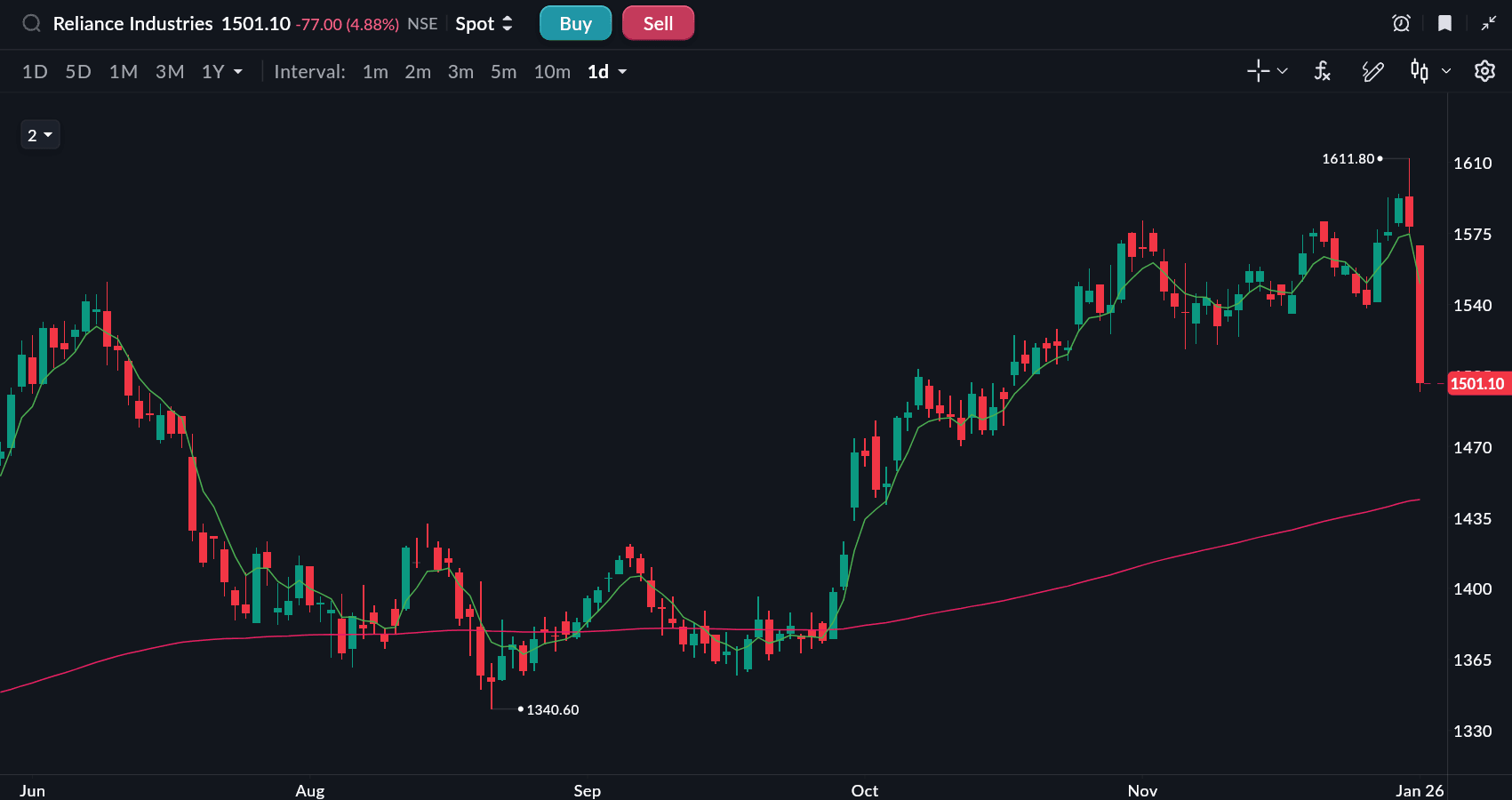
However, the stock has slipped below its 5-day EMA, which usually signals short-term momentum exhaustion, a warning for positional traders.
This tells us something important: The fall is not about broken fundamentals, it's about risk repricing.
Why Traders Should Care
RIL isn’t just another stock in the index it’s an index driver.
When RIL moves, the Nifty’s tone changes.
A sharp fall in Reliance usually signals:
- Institutional risk reduction
- Caution in energy-linked exposures
- Sensitivity to global policy flows
Which means:Even if your portfolio doesn’t hold RIL, your trades are still affected by it.
The Bottom Line
Reliance’s fall wasn’t random.
It was a repricing of geopolitical risk, trade uncertainty and refinery narrative exposure compressed into a single trading session.
For now, the structure is intact.
But the message from the market is clear:
Global politics are now part of your chart pattern.
And in 2026, that may matter as much as your moving averages.