
Why Is PC Jeweller (PCJ) Shares Under Pressure?
Revenue stagnation, high debt, weak ROE and technical breakdowns keep PCJ shares under sustained selling

Team Sahi
Shares of PC Jeweller continue to face selling pressure amid concerns around revenue stagnation, elevated leverage, and weak return ratios. Recent price action reflects both fundamental stress and technical breakdowns, reinforcing cautious investor sentiment.
Let’s break it down clearly.
Fundamental Weaknesses: Growth and Balance Sheet Concerns
At the core of the problem is growth — or the lack of it.
Stagnant Revenue Growth
Over the last five years, PC Jeweller’s net sales have contracted at a CAGR of approximately –1.24%. In a sector where organised jewellery players have expanded aggressively, negative revenue growth signals structural challenges.
For a consumer discretionary business, revenue stagnation usually reflects:
- Weak store expansion
- Demand-side constraints
- Loss of competitive positioning
- Trust and brand-related issues
High Leverage and Liquidity Risk
The company’s debt-to-EBITDA ratio of 29.78 stands out as a major red flag. This suggests operating earnings are insufficient relative to outstanding debt obligations.
While the company has taken steps toward reducing debt, leverage remains elevated. High debt:
- Limits financial flexibility
- Increases refinancing risk
- Compresses margins due to interest burden
In a rising rate or tightening liquidity environment, this becomes even more concerning.
Low Return on Equity
Return on Equity (ROE) hovering around 2% is significantly below industry standards. Investors typically seek double-digit ROE in retail and jewellery businesses due to high working capital efficiency and brand-driven pricing power.
A 2% ROE suggests:
- Weak capital allocation
- Low profitability
- Poor shareholder value creation
Technical and Market Pressures: The Downtrend Deepens
Even when fundamentals are weak, technical levels often determine short-term price action — and PCJ’s charts haven’t offered much comfort.
52-Week Lows
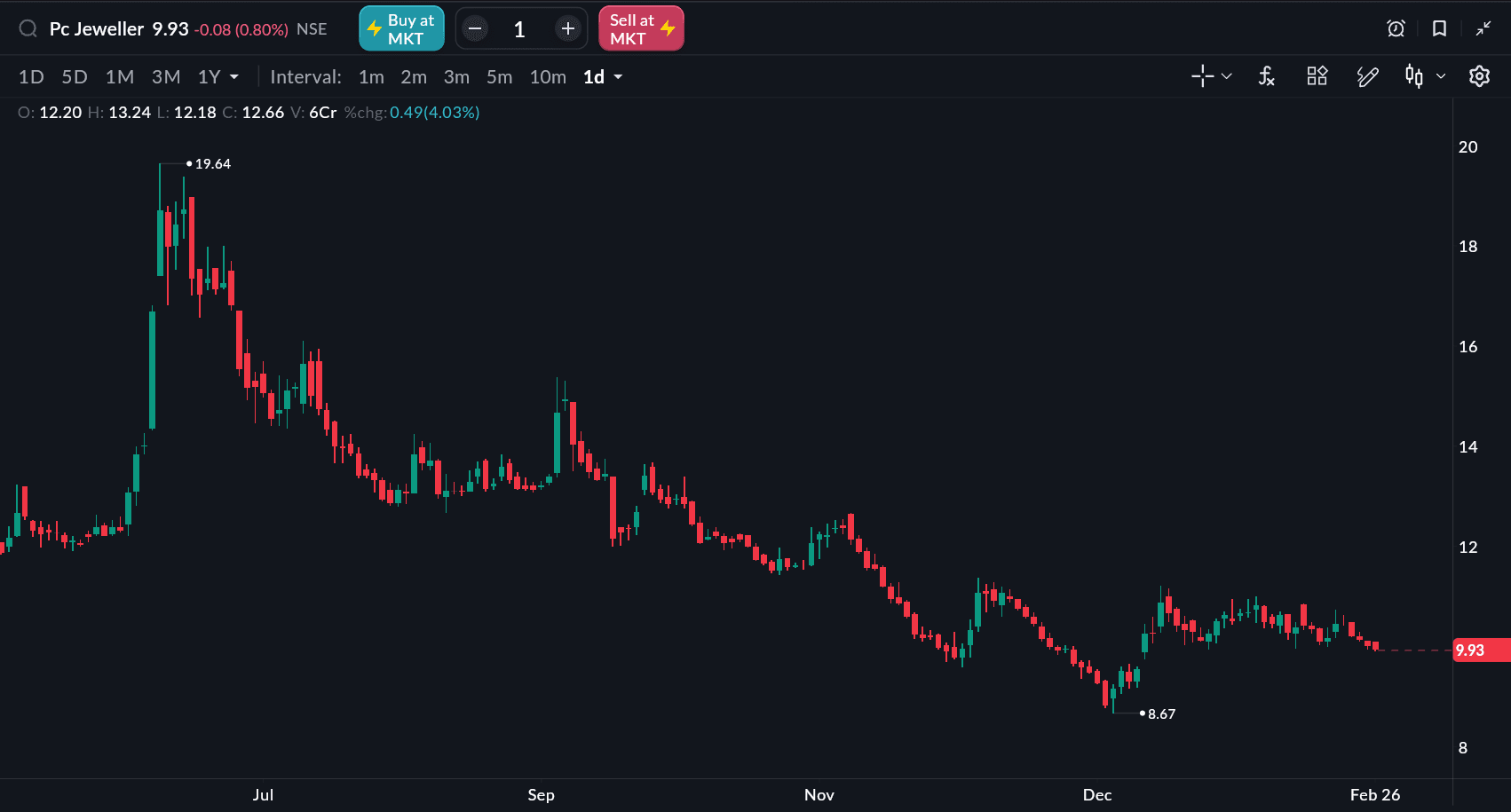
The stock recently touched a 52-week low near ₹9.96, indicating persistent selling pressure. Importantly, this decline occurred even when broader indices such as the BSE Sensex were relatively stable, showing stock-specific weakness.
Trading Below All Key Moving Averages
PCJ is trading below its:
- 50-day moving average
- 100-day moving average
- 200-day moving average
When a stock trades below all major moving averages, it signals:
- Strong bearish momentum
- Institutional avoidance
- Absence of trend reversal
Breakdown of Support Levels
Technical breakdown below support zones around ₹12.74 has accelerated the decline. Immediate resistance now lies in the ₹13.50–₹14 range, meaning any bounce may face selling pressure.
Additional Surveillance Measures (ASM)
Exchanges have placed the stock under Additional Surveillance Measures due to high volatility. ASM typically:
- Restricts intraday leverage
- Increases margin requirements
- Reduces speculative participation
This often leads to liquidity tightening and sharper price swings.
Investor Sentiment: Trust Deficit Persists
Perhaps the most difficult challenge for PC Jeweller is rebuilding trust.
Low Institutional Participation
Institutional ownership remains limited. Large funds tend to avoid companies with:
- Governance overhangs
- Debt stress
- Inconsistent financial reporting
The absence of strong institutional backing amplifies volatility.
Legacy Legal and Insolvency Concerns
The company has faced legal disputes and insolvency-related risks in the past. Even if operational metrics improve marginally, market memory of such episodes lingers.
In equity markets, perception often moves faster than recovery.
Underperformance vs Benchmarks
On a year-over-year basis, PCJ has underperformed the BSE Sensex by over 34%. When a stock significantly lags benchmark indices, passive and momentum-driven flows typically avoid it.
Can PC Jeweller Regain Its Shine?
A turnaround is not impossible — but it would require:
- Sustainable revenue growth revival
- Meaningful debt reduction
- Improved ROE and operating margins
- Clear governance signaling
- Institutional re-entry
Until then, the stock may remain vulnerable to:
- Technical breakdowns
- Sentiment-driven sell-offs
- Volatility spikes
The Bigger Picture
PC Jeweller’s decline is a classic example of how markets price in more than just quarterly results. When fundamentals weaken, leverage rises, and sentiment erodes, even short-term positive triggers struggle to sustain rallies.
For investors, this is a reminder:
Balance sheet strength and credibility often matter more than temporary profit spikes.
The real question now is not whether the stock can bounce but whether the business model can structurally rebuild confidence.
And in markets, confidence is everything.
Related
Recent
Zomato Share Price Falls for 8 Straight Days. What's Really Going On?
Why Holi Flight Prices in 2026 Are Up 185% — And What's Really Behind the Surge
RFC OFS: Find Out the Main Reasons Behind the Stake Sale
Defence stocks rally as Indian PM visits Israel: what's driving the buzz
Nvidia's $68 Billion Quarter: What It Really Means for AI — and Whether the Hype Is Justified