
Union Budget 2026, Numbers, Market Impact and What Traders Must Do
Budget 2026 analysis covering key tax changes, higher STT impact on traders, capex push, and manufacturing incentives. Know what it means for Indian equity markets and investors.

Team Sahi
2026 Union Budget Updates
The union budget of 2026 isn’t a loud, headline-heavy budget; it’s a signals-driven one, focused on execution, capital allocation, and targeted market reforms.
In the 2026 budget the highlighted areas were around public capex, which remains front and center; fiscal consolidation continues; and tax changes are targeted—with a few direct consequences for equity markets and traders.
Market-facing tax & structural changes
Unlike earlier years, where capital market taxation was left untouched, Budget 2026 makes several targeted interventions that directly affect equity investors, traders, and listed companies. Below are the tax and market-structure changes that most affect equity investors and traders, followed by practical implications.
Headline market tax changes:
| Change | What it is | Market implication |
|---|---|---|
| Buybacks | Proceeds taxed as capital gains in shareholder hands; the promoter's effective tax: 22% (corporate) and 30% (non-corporate). | Buybacks lose some tax arbitrage; price reaction depends more on capital-allocation quality. |
| STT (Futures) | 0.02% → 0.05%. | Intraday/futures costs increase materially for high-turnover strategies. |
| STT (Options premium & exercise) | Premium and exercise → 0.15% (from 0.10% / 0.125%). | Options hedging and spreads become costlier; adjust hedging frequency/size. |
| MAT (Minimum Alternate tax) | Made final tax; rate reduced 15% → 14%; brought-forward MAT credits and set-off rules modified. | Corporate tax clarity; impacts cash flows and payout planning. |
| Income Tax Act, 2025 | New Act effective 1 Apr 2026; simplified forms and staggered filing timelines. | Easier compliance and reduced administrative uncertainty for retail and institutions. |
Deeper look at buybacks, STT, and trader economics
The buyback change is structural: taxing buyback proceeds as capital gains removes a preferential pathway that earlier allowed certain promoter/shareholder combinations to extract value with favourable tax treatment. For companies, buybacks are still a capital-allocation tool, but after-tax math for recipients has changed; markets should price the quality of buybacks (why management is returning capital) rather than assume a pure tax-arbitrage pop.
STT increases are more operational for traders: the bump in futures STT to 0.05% and options premium/exercise to 0.15% raises per-trade costs. For low-margin, high-frequency strategies this is non-trivial—it reduces edge and demands an immediate re-check of slippage, turnover, and margin usage. As a result, re-run your strategies and recalculate your real-cost P&L rather than relying on only profit/loss figures. All the more, because STT is an unavoidable cost, which is now higher than before.
Even the Nifty50 reached strongly after these announcements: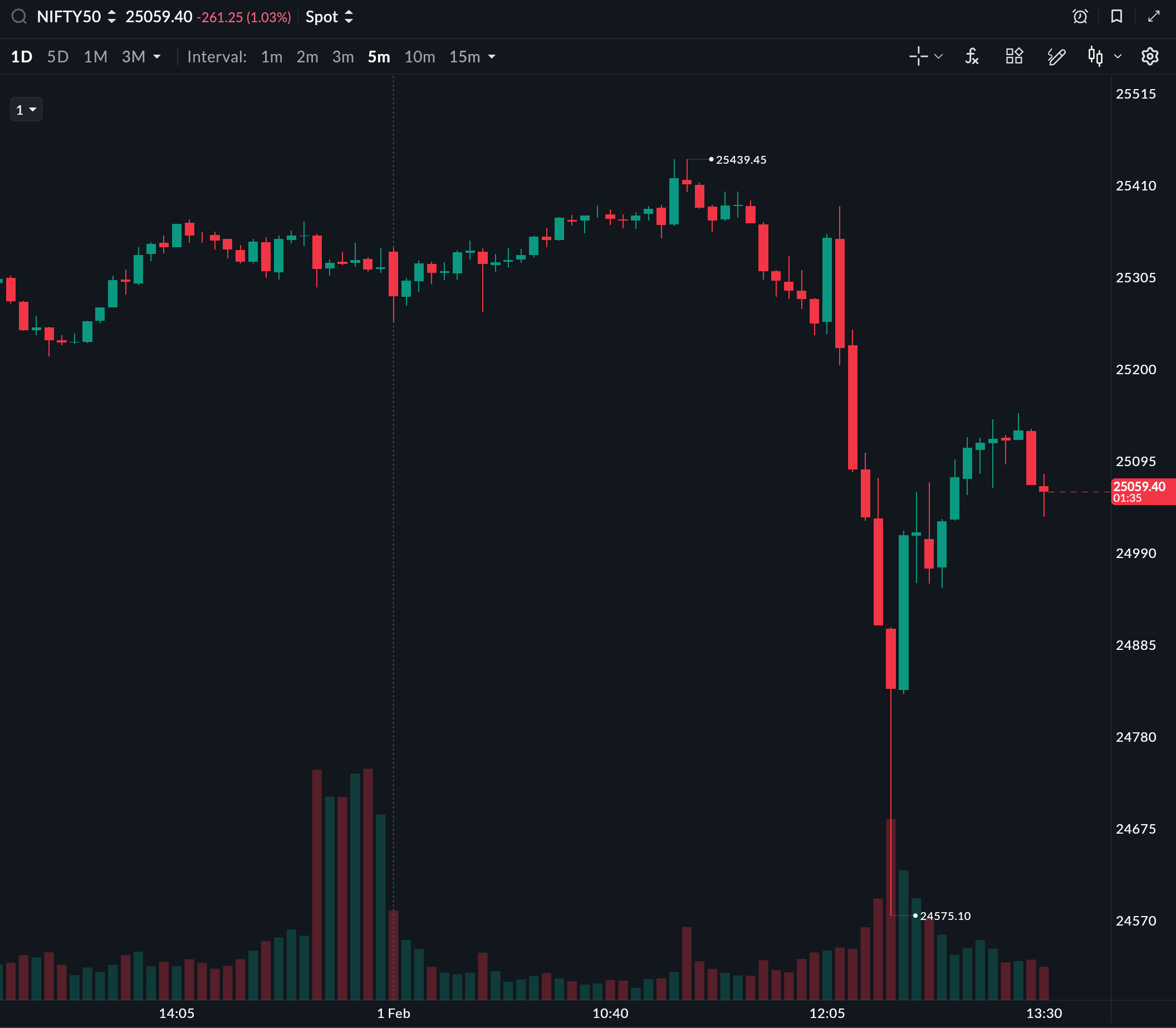
Top numbers at a glance
| Item | Figure |
|---|---|
| Capex (BE 2026–27) | ₹12.2 lakh crore. |
| Net market borrowings | ₹11.7 lakh crore. |
| Gross market borrowings | ₹17.2 lakh crore. |
| Fiscal deficit (BE 2026–27) | 4.3% of GDP. |
| Debt-to-GDP (BE 2026–27) | 55.6% (vs 56.1% RE 2025–26). |
Why do these numbers matter to markets?
The capex number (₹12.2 lakh crore) continues a multiyear government push that feeds demand into cement, steel, capital goods, and engineering. Borrowing plans are explicit: net borrowings of ₹11.7 lakh Cr set the supply of government paper that markets must absorb; this directly influences bond yields and bank liquidity, which in turn affect rate-sensitive sectors and equity valuations. Fiscal consolidation (4.3% target) reduces macro risk premium over time — a constructive backdrop for longer-term equity allocations.
Where the money is going:
- Roads, highways, and logistics corridors
- Railways and freight infrastructure
- Urban infrastructure in Tier II & Tier III cities
- Renewable energy and power transmission
The government reaffirmed that India’s economy continues to grow at around 7%, despite a challenging global environment. This growth is being supported not by consumption stimulus alone, but by structural reforms, public investment, and financial stability.
Manufacturing & Industrial Policy:
Manufacturing remains central to India’s growth strategy, with targeted schemes backed by large allocations.
Key announcements:
- Electronics Components Manufacturing Scheme: Outlay increased from ₹22,919 crore to ₹40,000 crore
- Rare Earth Corridors: Dedicated corridors to be set up in Odisha, Kerala, Andhra Pradesh, and Tamil Nadu to support mining, processing, and manufacturing
- Container Manufacturing Scheme: ₹10,000 crore allocation over 5 years to build a global-scale container manufacturing ecosystem
- Revival of 200 legacy industrial clusters through infrastructure and technology upgrades
These measures support long-term earnings visibility for industrials, electronics manufacturers, logistics players, and export-oriented firms.
Furthermore, the 2026 budget has recognised cities as growth multipliers and introduced City Economic Regions (CERs).
- Allocation: ₹5,000 crore per CER over 5 years
- Focus on Tier II, Tier III cities and temple towns
Transport & connectivity highlights:
- 7 High-Speed Rail corridors, including Mumbai–Pune, Delhi–Varanasi, and Chennai–Bengaluru
- 20 new National Waterways to be operationalised over 5 years
- Coastal cargo share targeted to rise from 6% to 12% by 2047
MAT and corporate tax tweaks: what to watch next
Making MAT final at 14% (earlier 15%) while allowing limited set-offs of brought-forward MAT credit alters corporate behaviour. Firms weighing a move to the new tax regime will factor in the limited MAT credit set-off rules. For the market, this changes expected cash flow and may impact decisions around dividends, buybacks, and capex vs. return-of-capital choices.
Selected allocations and programmes
| Sector / Programme | Allocation / change | Why it matters |
|---|---|---|
| Infrastructure / capex | ₹12.2 lakh crore (FY26–27) capex proposed. | Sustained demand for cement, steel, EPC, and construction equipment. |
| Electronics manufacturing | Electronics Components Scheme: ₹40,000 crore (up from ₹22,919 cr). ISM 2.0 to follow. | Strengthens domestic supply chain; positive for component makers and ancillary suppliers. |
| Exports (textiles, leather, seafood) | Duty-free seafood inputs: 1% → 3% of FOB; export time window extended for some sectors. | Improves margin predictability for exporters; supports near-term revenue visibility. |
Indirect taxes — why they still matter to equity investors
Indirect tax changes (customs, excise rationalisation and process reforms) alter company margins and capex economics.
Extensions of duty exemptions for lithium-ion manufacturing and nuclear project inputs, longer validity for advance rulings, and digital customs process improvements reduce input costs and compliance frictions. This is particularly for exporters and import-dependent manufacturers. These are second-order but persistent drivers of corporate profitability.
Immediate actions for traders and active investors
| Action | Why |
|---|---|
| Reprice F&O strategies with new STT | Higher statutory cost directly reduces per-trade edge. |
| Review buyback-exposed names | Factor new after-tax proceeds for shareholders and revisit thesis (buyback vs dividend). |
| Monitor borrowing calendar & bond yields | ₹11.7L net borrowings affect liquidity and interest-rate expectations. |
Conclusion
While the budget of 2026 is not a shock to markets, it is a scaffolding of predictable policy and capital that supports multiyear themes. For traders, the most immediate element is higher trading cost via STT and a recalibration required for strategies that depended on ultra-low per-trade expenses. For investors, the Budget affirms a long horizon: capex and manufacturing pushes (₹12.2L capex; ₹40,000 cr electronics outlay; CCUS ₹20,000 cr) provide clear sectoral direction. Tax changes (buybacks, MAT) are material and require updated after-tax models, but they do not upset the overall case for India’s growth story.
Related
Recent
Zomato Share Price Falls for 8 Straight Days. What's Really Going On?
Why Holi Flight Prices in 2026 Are Up 185% — And What's Really Behind the Surge
RFC OFS: Find Out the Main Reasons Behind the Stake Sale
Defence stocks rally as Indian PM visits Israel: what's driving the buzz
Nvidia's $68 Billion Quarter: What It Really Means for AI — and Whether the Hype Is Justified